Interviewing Mira Mikati and her employee, Phi Bureau, was a pleasure. As someone who adores Mira’s brand and her new concept store, I couldn’t be happier that she agreed to participate in this project. In this podcast, I discuss her brand identity and her rise to popularity alongside the uniqueness of a fashion company that doesn’t operate on the tradition runway show schedule. She answered questions about how she adapted to the pandemic as a retailer, along with what changes she made to her products due to the cultural shifts created by the pandemic.
Focus: Zooming in on Remote Learners with ADHD
Today is my second-to-last day as a college freshman. So far, I’ve spent the entirety of my college experience online – and as a student with ADD, it hasn’t been easy to manage my workload while sitting at the same desk all day. I wanted to create a video to try to capture this experience, so I used my contacts to find an education specialist who I could speak to. I interviewed Dr. Nanda Shaheen on Zoom, and recorded the interview for the purposes of my video. Given that she completed her PhD on the subject of students with learning disabilities (mainly focused on ADD and ADHD) and hypermedia, she was incredibly adept at responding to the subject of how ADHD students react to remote learning. I interviewed three other college-aged students who have ADHD in order to get their first hand perspectives of the subjects Dr. Shaheen was discussing. I was sure that I wanted the entire video to be composed of Zoom recordings and internet-based footage in order to represent what the Zoom classroom was like and to give it a digital-age feel. For example, in my intro, instead of recording myself speaking I screen-recorded google searches that reveal what the video is about.
After I had completed my interviews, I cut them down on FinalCut Pro until I was left with short, snappy clips that could retain a viewer’s attention. Cutting the interviews down was the longest part of the process because I also tried my best to get rid of filler words such as “um”, “like”, etc. After I organized the content on FinalCut, I searched for visual aids such as images of Zoom classrooms and headlines about remote learning, and layered these over certain sound clips. I used a dystopian-sounding ambient music track from a free music collective for podcast creators, and played around with the volume settings for it to fade naturally in and out of the intro and conclusion of the clip. I hope you enjoy watching this as much as I enjoyed creating it!
Podcasts Worth Listening to: “Something Large and Wild” from This is Love and “The Case of the Missing Hit” from Reply All
I’m embarrassed to report that I’ve never been one for podcasts – they always seemed to me like a pointless excuse for millennials to crack open a beer and chat. Normally, I finish an episode and think, “Why exactly did these people think the internet would care about their banter?” However, “The Case of the Missing Hit” from Reply All changed my mind. The episode follows Tyler Gillett, a filmmaker from California, attempting to track down a song from his childhood that is obsessively stuck on repeat in his head – but the catch, is that he can barely remember the melody to it. Anyone who hasn’t been able to shake a nagging melody can relate to Gillett’s dilemma, yet few would have the tenacity to search for a song like he did.

PJ Vogt and Alex Goldman’s (the hosts of Reply All) depiction of how we respond to madness is what makes the episode so fascinating, but the buzzy, fast-paced search for the song is what makes it so thrilling. The episode opens with a candid monologue from Vogt about his own OCD, drawing the listener into what appears at first to be an episode of the ever-so-popular psychological podcast genre. Quickly but effortlessly, Vogt and Goldman manage to capture a mystery with a near “true-crime feel” by including a series of dialogues from a host of “sound detectives” such as Steven Page, the lead singer of Barenaked Ladies, Rolling Stone writers, and even a band hired to recreate the tune.
As the search progresses, Gillett’s madness only intensifies. The listener is submerged in his obsessive self-questioning – is the song merely a figment of his imagination? Is it a mash-up of other 90’s tunes he heard on the radio as a kid? Or, just maybe, could it exist at the back of a dusty record store somewhere in the world? Finally, Gillett and the team discover that the song really does exist, and that it was created by a musician called Evan Olson in the 90s. Their relief and joy at the discovery is palpable, making this tale not just exhilarating but heartwarming.
My newfound love for podcasts made discovering “Something Large and Wild” from This is Love all the more exciting. The episode tells a poignant tale of unlikely friendship between 17-year-old Lynn Cox, a long-distance swimmer, and a baby blue whale. Cox’s breathless-sounding voice and the ethereal soundtrack made me feel as though I was actually submerged in water, and I understood her experience as though I was there. The story begins with a cryptic soundtrack as Cox describes her swim. She describes “water hollowing out” and as the soundtrack rises to crescendo, she realizes that a slipstream is pulling her under. “Usually water always feels fluid and wraps around you,” she remarks knowingly as she recounts maintaining a level head amid fears that she may be swimming with a shark.
Despite there being few characters in this story, Cox describes each of them elegantly – adding a personal, nostalgic flair to the story. She recounts how the old man who ran the pier watched over her as she discovered that she was actually swimming with a baby whale, not a dangerous sea creature. And, the baby whale himself is brought to life by lilting sounds of water and a melodic crescendo. “I touched her and I could feel that she felt my hand on her. And it was amazing,” said Cox during an expression of awe at the wonder of nature.

The Pandemic and College Student Mental Health: Information and Resources for Georgetown Students
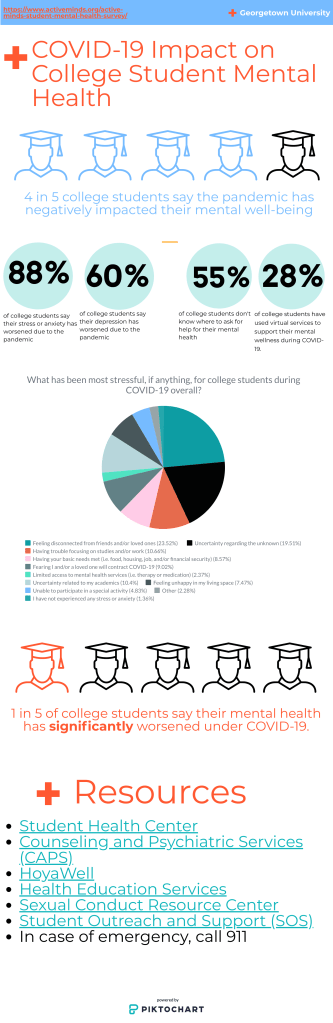
The pandemic has been detrimental to the mental health of students globally. Georgetown’s decision to remain virtual may be a source of stress and anxiety to many of its students, and I wanted to represent the mental health patterns of college students all over the country in order to demonstrate that no student is alone in this. For this infographic I used data from Active Minds’ September 2020 survey, which includes the data of 2,051 students from all over the United States. I also used Georgetown’s website to consolidate important resources for students suffering emotionally during this difficult time.
The National Gallery Sculpture Garden reopens for Valentine’s Day – and the love language of art is still alive, even in a pandemic
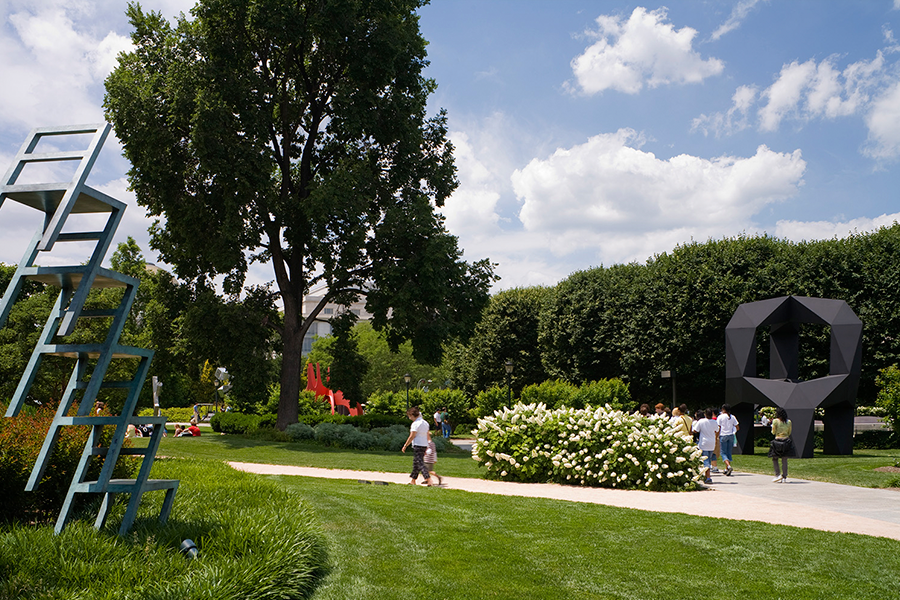
Washingtonians gathered at the National Gallery Sculpture Garden on Feb. 14th to celebrate its reopening, despite most D.C. museums and galleries remaining closed due to the pandemic. The garden closed in November as cases rose exponentially in D.C., but reopened as a “valentine to our visitors,” said National Gallery of Art director Kaywin Feldman.
Pavilion Café, a D.C. family favorite, also reopened with a full takeout menu. Patrons are required to wear masks and observe social distancing regulations, but this didn’t stop couples and families from taking strolls (safely) in the sculpture garden as part of their Valentine’s Day festivities.
Despite last Sunday’s gray weather, children played with Roy Lichtenstein’s House I, a pop-art “house” that appears to move as you walk past it. Having grown up in D.C. myself, visits to the sculpture garden were a defining part of my childhood. I welcomed each winter skating with my friends in the sculpture garden’s ice rink (which is sadly closed), and my love for art grew at field trips to the museums on the mall. House was one of the first pieces of art I loved – it was when I was playing with it at the sculpture garden that I learned art was fun, a realization that defined my aesthetic as an artist.

For creatives like me, the pandemic has been a time of loss in terms of inspiration and motivation. While my classes remain online and my social interactions remain limited, I struggle to find the drive to create, the means to critique, and the gratitude to appreciate art. I haven’t felt that itch to make something (creatives: you know the one) since my high school abruptly closed on March 13th, 2020 – the day I finished my last painting. Watching a collective appreciation of art at Sculpture Garden’s reopening served as a reminder that the love language of art isn’t dead.
I watched couples and families while they watched the artwork. A young couple dressed up in Valentine’s-themed formal clothing stopped in front of each sculpture to discuss it in what seemed like they were trying to prove their cultural knowledge to each other. The girl stumbled in her heels (probably not the best choice for the day’s rain and sleet), while her boyfriend held her hand lovingly. Most couples declined to comment on their experience, and one member of a pair said “It’s Valentine’s Day! Any other day I would,” which may be a testament to the reopening’s success.
Hannah Freedberg, an associate director at Gagosian Gallery London, believes that Valentine’s Day was the perfect time for the garden to reopen. “How you respond to a work of art is a subjective, passionate and visceral experience – just like love. The long-standing relationship between art and love is absolute and never-ending, perhaps because both art and love are languages, a visual and spiritual way of communicating,” she said.
Freedberg herself is recently engaged, and she says that a celebration of art drew her and her fiancé together. “Two days after we first met, Giles (her fiancé) came to a Howard Hodgkin opening at the gallery I work at. It was only the second time we’d met and he brought his parents along! It was a beautiful show – but sad – the first the gallery had following Hodgkin’s passing that year,” said Freedberg.
Freedberg and her fiancé don’t always agree about whether a piece of art is good or bad, but she feels that debates about art are central to her relationship. “That’s the wonderful thing about art, everyone reacts and responds differently,” she said. “It’s helpful to have a healthy debate on what works are satisfying and why.”
I chatted with an elderly couple while waiting in line for coffee at the Pavilion Café during my visit to the Sculpture Garden. They had been together for fifty-two years, and had planned a visit to the sculpture garden as the main event of their Valentine’s Day celebrations. “This place is so D.C… I’ve lived here my whole life so it feels weird for museums to be closed. I definitely think they can open safely – we need art!” said the husband, who asked to remain anonymous. “We used to go to museums all the time when we first met. It’s romantic to fall in love over art,” said his wife.
5 Social Media Newsmakers to Follow
Mona Chalabi
Mona Chalabi is a New York-based data journalist who is most well-known for her eye-catching charts. Apart from being a multi-talented media wizard who’s resumé already consists of FiveThirtyEight, the Bank of England, the Economist Intelligence Unit, the International Organization for Migration, the Guardian, and multiple podcasts, Chalabi also identifies as a multidisciplinary artist. Her Instagram page mostly consists of colorful, quirky digital drawings each based on hard data. Her ideology is that hard data is often “decontextualized” and “dehumanized” in the media, and she seeks to represent statistics through a more human-friendly narrative. She also is keen on addressing the biases we approach numbers with. “I think everyone approaches a dataset with their own lived experience,” she said in an interview with Artnet. Personally, her charts were influential to my understanding of COVID-19 data. In a sea of misinformation on the virus, Chalabi used easy to understand (and beautiful) graphics to represent data from reliable sources on mask-wearing, antibody testing, hospital beds, and social distancing. Chalabi embodies the ideology that the news does not need to be dry and boring, despite the life-or-death stakes of the data she seeks to present. If all news were aesthetically pleasing, maybe people would tune-in more.
Humans of New York
I’ve been a loyal follower of @humansofny since 2014. What started as a photography project to capture the faces of 10,000 New Yorkers has now evolved into one of the most thorough journalism feats I’ve ever seen – an account that posts mini feature stories on different individuals from different socioeconomic and racial backgrounds. What I find so interesting about Humans of New York is that it does not only feature the stories of those who are traditionally “newsworthy and notable” – it truly embodies the motto that there is a story everywhere, and a good journalist can dig deep enough to find it. Journalists working for Humans of New York have incredible interview skills – they find just about anyone on the street and manage to extract their most gripping tales, from heart wrenching stories of soldiers’ PTSD to success stories in treating pediatric cancer. Sometimes the stories are about divorce or a death in the interviewees family, but they are always given justice in being addressed personally and sensitively. One interviewee told the story of one of her high school teachers who made an extra effort to check-in when the student showed signs of depression. “I’m about to begin my Master’s in education. I’m hoping to become the same kind of teacher as Mrs. Hunt. When I needed it most, she recognized my cries for help,” said the interviewee. There is a compelling quality to this kind of writing that merits reader attentiveness – no matter how small or mundane the tale may be. As a journalist, I hope to give each of my interview subjects the same respect, and I hope to keep in mind the important lesson that there is always a story to be told – it just requires time, attention, and most importantly, human empathy.
https://www.instagram.com/humansofny/
Leandra Medine Cohen
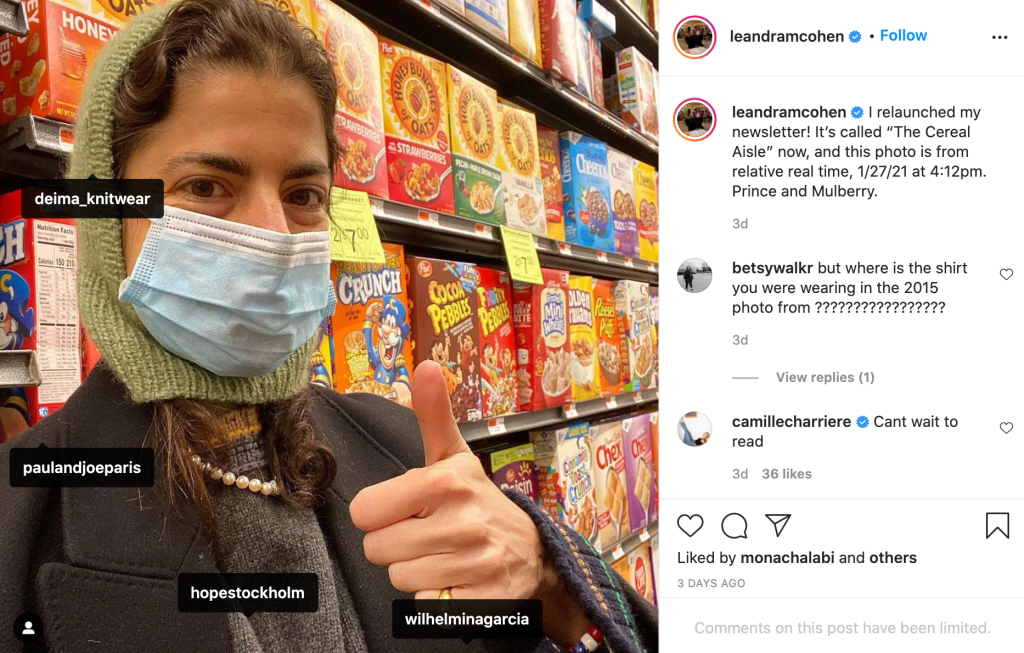
Out of all the people who may identify as “influencers,” I consider Leandra Medine the most akin to a true newsmaker. Medine is a fashion and lifestyle blogger who is most known for Manrepeller, her blog that debuted in 2010 and ended in 2020. As someone who is interested in fashion and lifestyle reporting, I value her unique approach of intellectual wit and humor in a superficial industry. For one thing, her out-of-the-box personal style lacks sex-appeal – a quality I revere in the current airbrushed media-scape of botox and lip-filler. Medine showcases her femininity through men’s shirts, balaclavas and vintage denim paired with ultra-femme pieces such as Amina Muaddi heels and the occasional lace chemise. She rarely wears makeup in her selfies, which are accompanied by witty, relatable captions such as “Y/N: high waist white jeans are a form of masochism in quarantine,” or “How will I ever succeed to potty train my kids when I can’t keep it in myself?” However, Medine’s personal style isn’t what makes her so impactful: Manrepeller taught fashion-loving young girls that wit and good style aren’t mutually exclusive. Her personal essays, many of which she posts excerpts of on Instagram, manage to be both highly intelligent and conversational, framing the seemingly mundane topics into gripping stories. She compared her transition out of her high-profile position at Manrepeller to growing pains in an essay that I revisited frequently throughout my first semester at college. “It’s like the bones in my thighs are trying to escape the agonizing sensation of pliers… There’s no way I will survive this – I am dying tonight,” she writes, describing a childhood memory of growing pains. Upon realizing there was a word for her condition, she was able to manage the ache. Despite the necessary (yet sorrowful to many) way in which Manrepeller was “cancelled” and shut down, Medine responded gracefully, and guided her 1m following through the trials and tribulations of transition in turn. If I choose to pursue fashion journalism, I hope to embody some of the humor, relatability, and transparency that Medine imbues into what could be a lifeless craft.
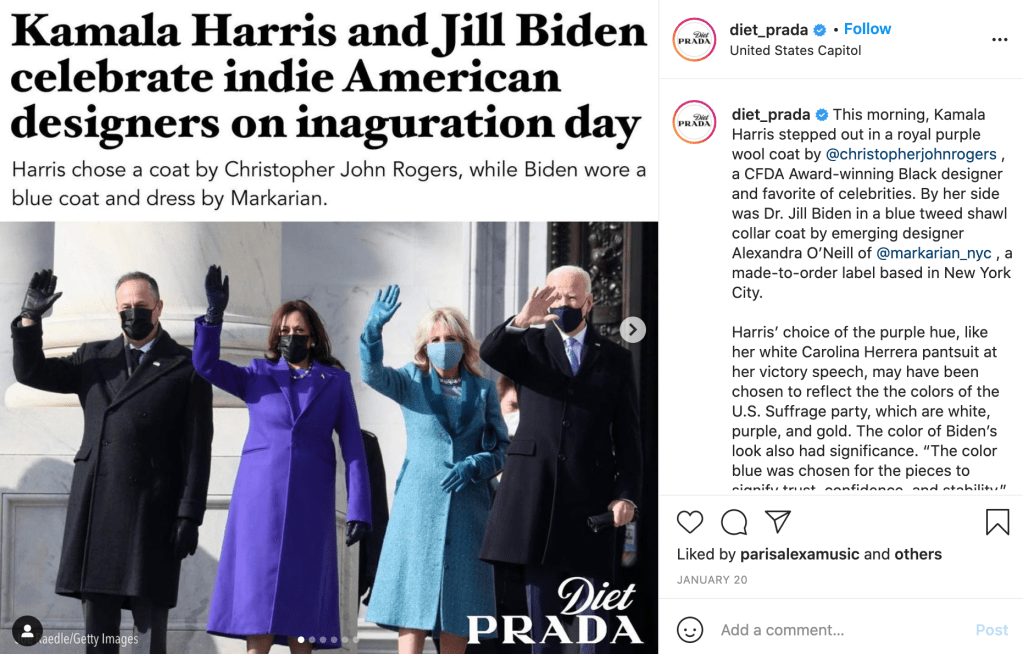
Diet_Prada
@Diet_Prada self-identifies as a “fashion watchdog group.” Along with simply identifying copied designs, the account draws attention to racism, misogyny, lack of diversity, and cultural appropriation in large and influential fashion corporations. Diet Prada’s cattiness is what makes it so unique, but it’s the genuine desire to uncover injustice in a “toxic” industry that makes it so worth reading. Despite being designers themselves, the founders of Diet Prada have no fear in addressing systemic issues in the fashion world – despite the possibility of being blacklisted by chiefs of corporations such as YSL, Dolce & Gabbana, Chanel, and more. “With its two million followers, catty tone, and encyclopedic knowledge of runway history, Diet Prada has been called ‘the most feared Instagram account’ in the industry by the Business of Fashion,” says Rachel Tashjian of GQ. In 2020 alone, Diet Prada exposed the famous Danielle Bernstein for stealing designs from small businesses, called out police officers for performative racism when seen pushing an elderly man to the ground before taking a knee with protestors, and busted Anthropologie for racially profiling customers. They also played a key role in exposing Reformation’s racist corporate culture (which came as a shock due to their “clean” branding), and most notably, making sure Alexander Wang was issued deserved shame for his sexual harassment allegations. With over 2.4 Million followers, the impact of Diet Prada’s posts is wide-ranging and powerful. However, their main message is as simple as this: newsmakers must have the guts to stand up to the “bad guys,” no matter how powerful they are.
Chrissy Teigen
I’m not hugely into influencer culture or celebrities on Twitter, but I do feel that Chrissy Teigen deserves recognition for her Twitter account. There’s a lot of talk on Instagram and TikTok right now about unfollowing influencers who don’t post their “bad days,” feigning that their beautiful “influencer life” is the reality they actually live in – and all their loyal followers must be consistently envious and self-resenting by contrast. I definitely agree that influential people on social media should be as real and raw as possible, and I view Chrissy Teigen as the pioneer of this attitude. Her posts (despite being so honest they make jaws drop) give an account of her whole life experience – the good, the bad, and the ugly, including everything from parenting “failures” to recipes for home-cooked junk food. When trying to describe the awe-spiring power of Chrissy Teigen’s tweets, Bustle described her as being like a “friend” to other women. “She shows her stretch marks on Instagram, she shows her bitchy side on Twitter… Whereas some celebrities appoint themselves to an untouchable status, Chrissy Teigen seems like a friend,” said Rosa Heyman, the Social Media Editor for Marie Claire. Personally, I found Teigen’s most influential moment to be her honesty in discussing her recent miscarriage. She posted a photograph of herself naked and crying on a hospital bed, and another of herself cradling the child who she lost. In the caption, she wrote “To our Jack – I’m so sorry that the first few moments of your life were met with so many complications, that we couldn’t give you the home you needed to survive. We will always love you.” For those who struggled with infant loss in private, Teigen’s braveness was a call to let them know they are not alone. Bustle points out that many celebrities are jumping on the “relatability” bandwagon on social media, but what sets Chrissy Teigen apart from other celebrities is that she lives and breathes social media – she understands the breadth of her following (no one really knows what she is famous for other than Twitter), creating a social media presence that is so comprehensive that women could even refer to it as their guide to womanhood.
 Camilia Fateh